
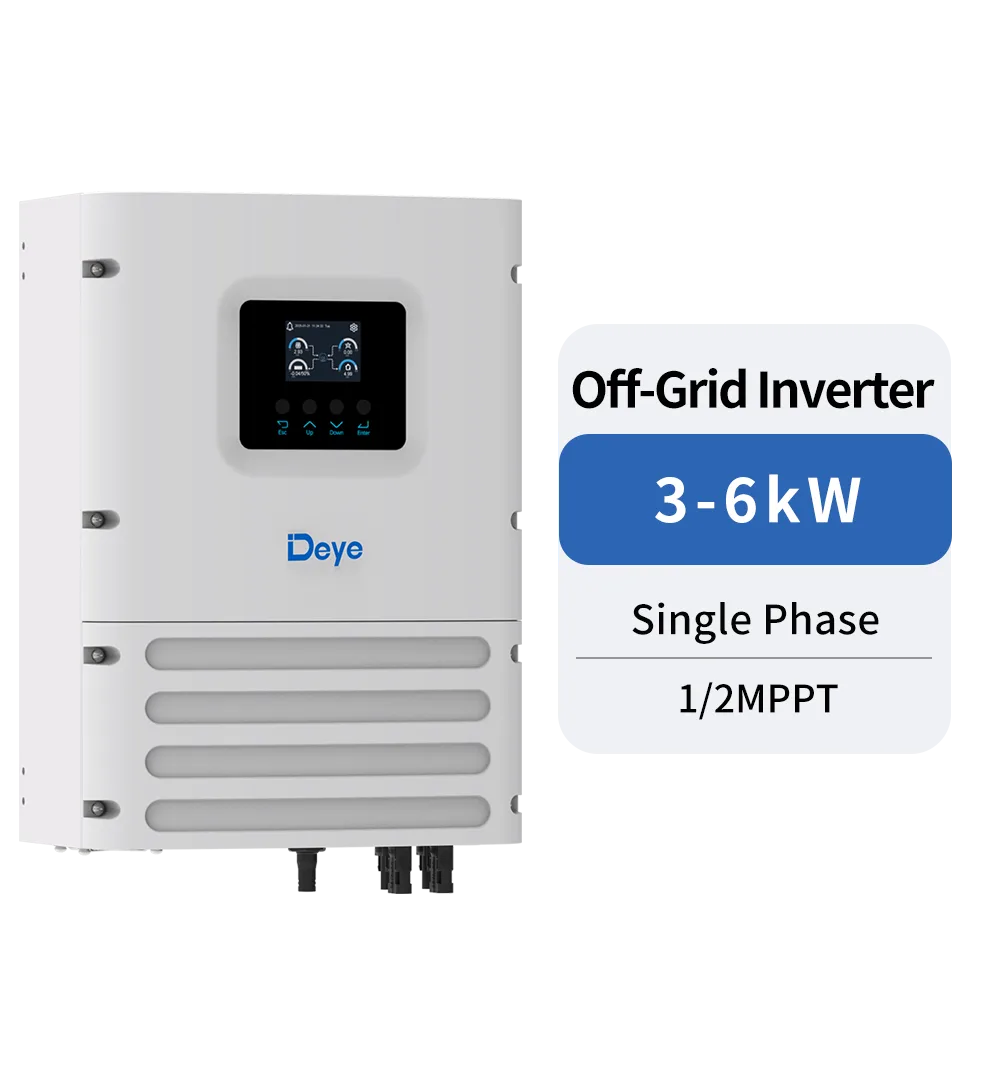
Compare the three displayed Deye off-grid inverter pages
Open the exact SUN-OG page for source-derived fields, then confirm the full suffix, current datasheet/manual, PV and battery design, generator/parallel options, accessories, availability and order terms.
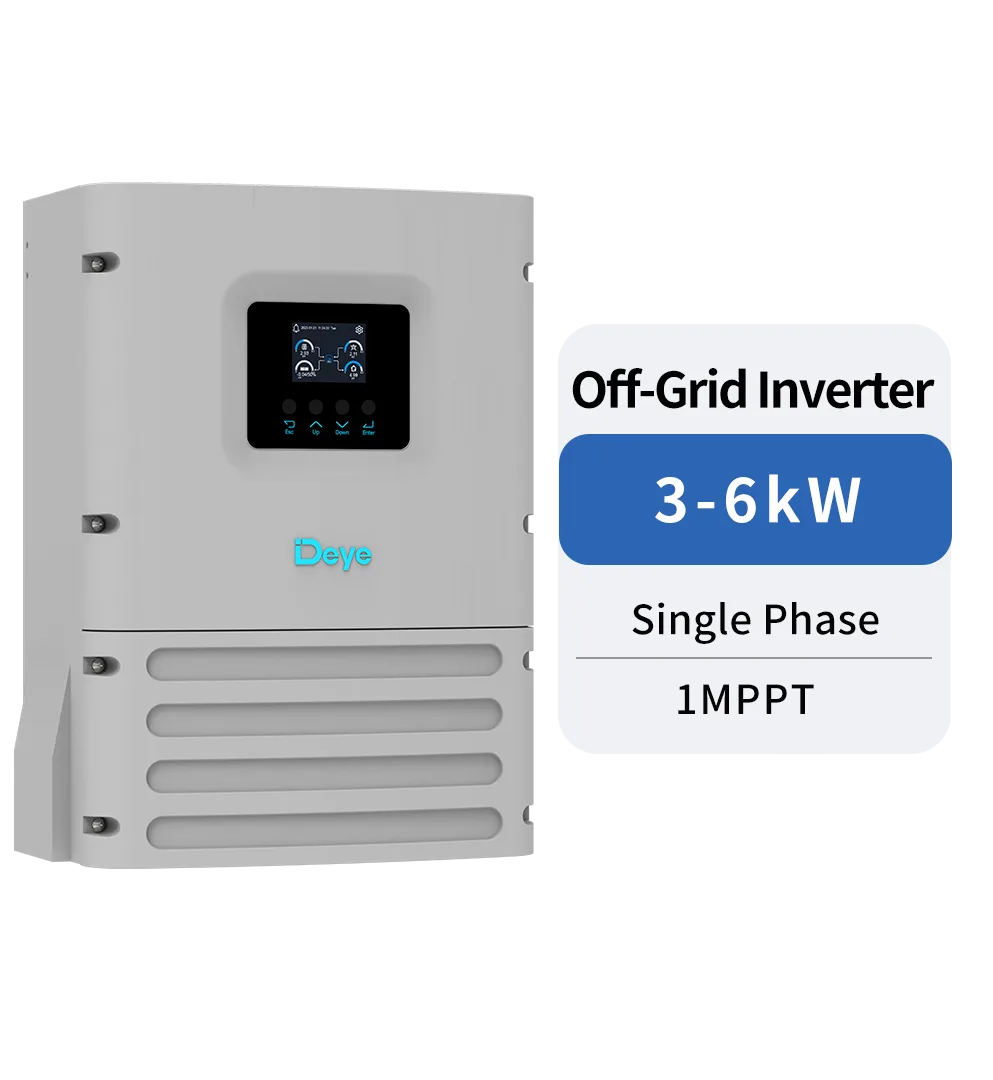
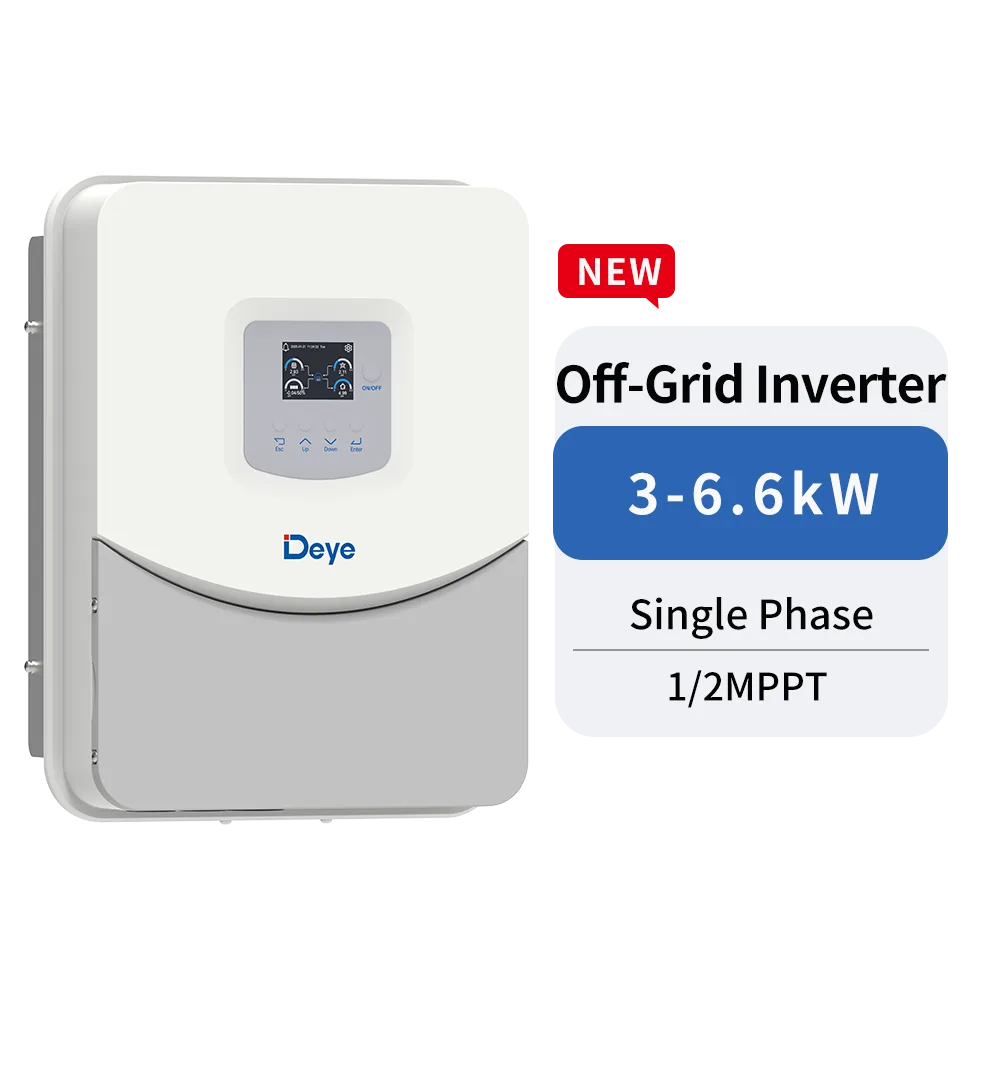
Displayed SUN-OG routes
Compare the three off-grid families by exact suffix and input design
The catalogue pages share an off-grid role but do not make their PV inputs, options, firmware or accessories interchangeable.
SUN-OG01 family
Displayed source tables cover 3/3.6/5/6 kW model ratings with battery, PV input and 230 V output fields. Confirm exact MPPT/input arrangement, battery window and files for the offered suffix.
SUN-OG02 family
Displayed 3/3.6/5/6 kW source content includes model-specific switching, parallel, Wi-Fi and generator-control statements. Treat each function as exact-model/manual scope, not a category-wide promise.
SUN-OG03 family
Displayed source tables extend through 6.6 kW and show model-dependent PV input/string arrangements. Confirm the exact AM suffix, current limits, battery interface, output and accessories.
Battery and generator system context
All three are components within a larger off-grid system. Battery bank, generator, transfer/bypass, distribution, protection, earthing, load shedding and monitoring require a matched project design.
Off-grid sizing checks
Six inputs before selecting a Deye off-grid inverter
Start from loads and operating hours, then verify PV, battery and generator interfaces against the exact source model and project conditions.
Load profile and peak demand
List continuous, daily and seasonal energy, simultaneous peak, motor/compressor starts, critical loads, allowable shedding and expected growth. kW alone does not define the system.
Autonomy and operating strategy
State required hours/days, renewable fraction, acceptable generator runtime, seasonal conditions and reserve policy. Battery kWh and PV size must be calculated from documented assumptions.
PV array and MPPT
Provide module data, temperatures, string length/count, orientation and shading; verify maximum PV voltage, MPPT range, current limits, inputs and charging power on the exact model.
Battery bank and BMS
Provide chemistry, exact battery model, voltage window, bank configuration, usable energy, charge/discharge current, BMS protocol, temperature limits, protection and approved compatibility evidence.
Generator, bypass and distribution
Define generator voltage/frequency/power, start/control method, input limits, transfer or bypass, neutral/earthing, output distribution, overload/short-circuit coordination and load shedding.
Environment, files and supply
Provide ambient temperature, altitude, enclosure/site, ventilation and service access; request exact datasheet/manual, settings, accessories, warranty, quantity, availability and commissioning scope.
System and runtime boundaries
An off-grid inverter model does not determine autonomy or a complete microgrid
Runtime, load support and generator behavior depend on the full PV-battery-generator-load design, settings, environment and installation.
Rated power is not an energy balance
Inverter kW does not determine daily energy, PV yield, battery capacity or autonomy. Use hourly/seasonal loads, losses, temperature, reserve and generator strategy.
Battery type labels are not compatibility
A table listing lead-acid or lithium-ion does not approve every battery. Confirm voltage/current, BMS communication, settings, protection, temperature and written model pairing.
Peak output needs exact conditions
Motor-start or overload support depends on magnitude, duration, battery/DC capability, temperature, simultaneous loads and the exact manual. Do not turn a short-duration figure into continuous capacity.
Generator functions need system design
Generator start/control, acceptable input, charging, transfer, bypass, neutral/earthing and protection must be verified for the exact model, generator and installation.
Continue the off-grid review
Connect the inverter to loads, battery and generator scope
Use the remote microgrid solution to frame the energy architecture and the inverter guide to keep operating roles and model boundaries clear.
Remote microgrid hybrid power solution
Review how loads, PV, storage, power conversion, generator, controls, site conditions and local design responsibilities form one remote-power scope.
Review solution context
Hybrid, on-grid and off-grid inverter guide
Use the operating-mode, battery, backup/load, PV, AC and document checklist before approving an off-grid inverter family.
Read the buyer guide
Deye off-grid inverter FAQ
Questions to resolve before fixing an off-grid power platform
These answers support procurement; final load study, PV/battery sizing, generator integration, electrical protection and commissioning remain project-specific.
Can inverter power alone size a Deye off-grid system?
No. Inverter kW addresses part of instantaneous load support. PV size, battery energy and generator strategy require hourly and seasonal loads, peak starts, autonomy, site resource, losses, temperature, reserve and operating priorities.
Can any 48 V-class battery be used with a Deye off-grid inverter?
Do not rely on nominal voltage alone. Confirm the exact battery and inverter voltage ranges, current, bank configuration, BMS protocol and firmware, charge settings, temperature limits, protection and written compatibility evidence.
Will a Deye off-grid inverter start every motor or compressor?
Not automatically. Compare the motor's starting method and measured/declared start demand with the exact inverter's overload conditions, battery/DC capability, temperature derating and other simultaneous loads. Load sequencing or a different architecture may be required.
What should a Deye off-grid inverter RFQ include?
Include load schedule and peaks, autonomy goal, site and solar conditions, exact module/string plan, battery make/model and BMS, generator and transfer/bypass needs, AC voltage/frequency, environment, protection, documents, quantity and commissioning scope.
Deye off-grid inverter procurement
Deye Off-Grid Inverters for Battery and Generator-Backed Loads
Compare three displayed SUN-OG source pages spanning 3–6.6 kW family ratings. The available source tables describe 230 V single-phase output families, PV/MPPT inputs and lead-acid or lithium-ion battery routes; model-level generator, parallel, switching and communication functions vary. Start with the load profile and autonomy goal, then confirm PV design, battery voltage/current/BMS, generator input, peak-load behavior, protection, manuals, destination requirements and complete order scope.
Prepare a Deye off-grid inverter RFQ from the load profile
Send hourly/daily loads and starts, autonomy, PV array, exact battery/BMS, generator and bypass strategy, AC system, environment, protection, documents, quantity and commissioning needs.