
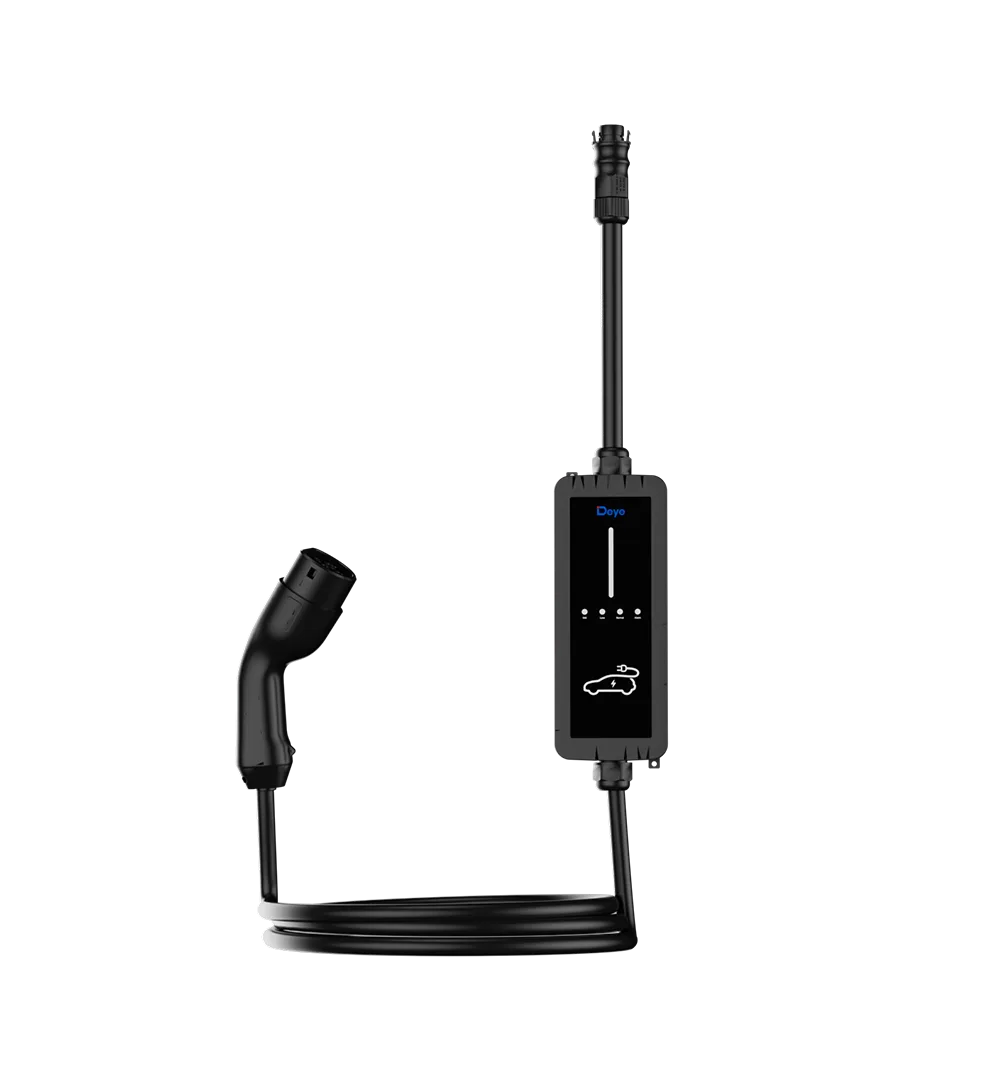
Review the displayed Deye Smart EV Charger page
Open the source-derived product page, then confirm the exact 11 kW or 7/22 kW model, phase/current, connector/cable, compatible inverter and controls, protection, standards evidence, services, availability and order terms.
Displayed charging routes
Match charger model, AC service and control architecture
The single source page contains more than one electrical route. Final charging power and solar-aware control depend on the exact model and complete site design.
11 kW three-phase route
The displayed SUN-EVSE11K01-EU-AC table describes 230/400 V, three-phase connection and 16 A input. Confirm exact vehicle interface, cable, protection, service and destination documents.
7/22 kW single-/three-phase route
The displayed SUN-EVSE22K01-EU-AC table describes 7 kW single-phase or 22 kW three-phase operation with 32 A input. Site phase and capacity determine the permitted route.
Scheduled and solar-aware charging
Define plug-and-play, time schedule or solar-energy control, inverter/LoRa link, meter/CT data, export/load limit, grid import allowance and behavior when communications or surplus changes.
Standalone versus Deye-integrated use
Confirm whether the charger is supplied as an AC EVSE or as part of a Deye inverter/cloud architecture. List compatible equipment, firmware, gateway/meter and included communications accessories.
EV charging project checks
Six checks before requesting a Deye EV charger quotation
A complete request connects the charger and vehicle to site capacity, protection, solar controls, network and local installation rules.
Vehicle and charging interface
Provide vehicle(s), onboard AC charging limit, connector/inlet standard, cable requirement, daily energy, dwell time, user access and future vehicle needs.
AC service and available capacity
State country, single/three phase, 230/400 V, frequency, service/transformer size, existing peak load, available current, diversity and whether dynamic load management is required.
Charging power and schedule
Select 7, 11 or 22 kW only after vehicle and site checks; define charging windows, target energy, tariff, demand limit, priority and behavior during outages.
Solar and inverter integration
Provide exact Deye inverter/ESS model and firmware, PV/export objective, meter/CT, LoRa/gateway/cloud, solar-only or grid-assist logic and communications-loss behavior.
Protection and installation
Confirm circuit, breaker, RCD/DC leakage approach, SPD, earthing, cable length/route, isolation, mounting, outdoor exposure, impact/access control, signage and installer/inspection requirements.
Files, services and supply
Request exact datasheet/manual/certificate references, cable/connector and communications BOM, app/cloud terms, warranty, labels, commissioning, quantity, availability and destination documents.
Charging and compliance boundaries
A smart charger feature does not approve the site or guarantee solar-only energy
Charging power, solar share and safety depend on the vehicle, electrical service, inverter/meter controls, protection, installation and local rules.
Maximum kW needs vehicle and site support
The EV onboard charger, phase, voltage, service capacity, conductor/protection and load-management limit can all reduce actual charging power.
Solar-only is a control objective
Actual grid import and solar fraction depend on measurement point, CT/meter accuracy, inverter/control response, PV variability, minimum charge current, settings and communications.
Deye integration is exact-model compatibility
An AC port and LoRa description does not prove compatibility with every Deye inverter. Confirm inverter/charger model, firmware, gateway/meter, protocol and written system instructions.
Standards listed are not destination approval
A standards table or IP/protection claim applies to the named model and evidence. Local EVSE, electrical, connector, utility, building and inspection requirements still govern installation.
Continue the charging review
Connect EV charging to the site's solar and electrical scope
Use the commercial solution for PV and service context, then control the charger, protection, communications and installation lines in the BOM.
Commercial rooftop solar solution
Review how daytime loads, PV, inverters, metering, protection and local electrical responsibilities frame solar-aware charging.
Review solution context
Solar BOM review guide
Record the exact charger, cable, protection, meter/CT, communications, cloud/service, installation and commissioning responsibilities.
Read the buyer guide
Deye EV charger FAQ
Questions to resolve before approving smart AC charging
These answers support procurement; final service capacity, protection, solar controls, connector compliance, installation and inspection remain project-specific.
Can every vehicle charge at 22 kW from the Deye Smart EV Charger?
No. The vehicle's onboard AC charger, connector, three-phase support, site voltage/current, service capacity, conductor/protection and load-management settings determine actual power. Some vehicles or sites will charge at a lower rate.
Does solar-only mode guarantee that no grid energy is used?
Do not treat the label as an energy guarantee. Confirm the meter/CT location and accuracy, inverter/charger control, minimum EV charging current, PV variability, response delays, export/load settings and behavior during communications loss.
Can the Deye Smart EV Charger integrate with any Deye inverter?
Confirm the exact inverter and charger model, firmware, AC connection, LoRa or other communications, meter/CT/gateway, cloud/app and supported control mode in the current documentation. Same-brand equipment is not automatically compatible.
What should a Deye EV charger RFQ include?
Include destination, vehicle/connector, daily energy and dwell time, target 7/11/22 kW, phase/voltage/service capacity, load management, exact inverter/ESS and meter/CT, solar-control mode, protection, cable/mounting/network, required files, quantity and commissioning scope.
Deye EV charger procurement
Deye Smart EV Charger for Solar-Aware AC Charging Projects
Review the displayed Deye Smart EV Charger source page and its 11 kW and 7/22 kW model routes. Source tables describe single- and three-phase AC options, LoRa/Wi-Fi/BLE communications and plug-and-play or scheduled modes; source content also describes inverter-linked and solar-energy modes. Confirm the exact model, site service capacity, vehicle/connector and cable, phase/current, inverter and meter integration, protection, load/export control, mounting, network, standards evidence, installation and destination approval.
Prepare a Deye EV charger RFQ by vehicle and site capacity
Send the destination, vehicle/connector, target power and schedule, phase/voltage/service capacity, exact inverter/meter integration, solar/load controls, protection, cable/mounting, documents, quantity and commissioning scope.