
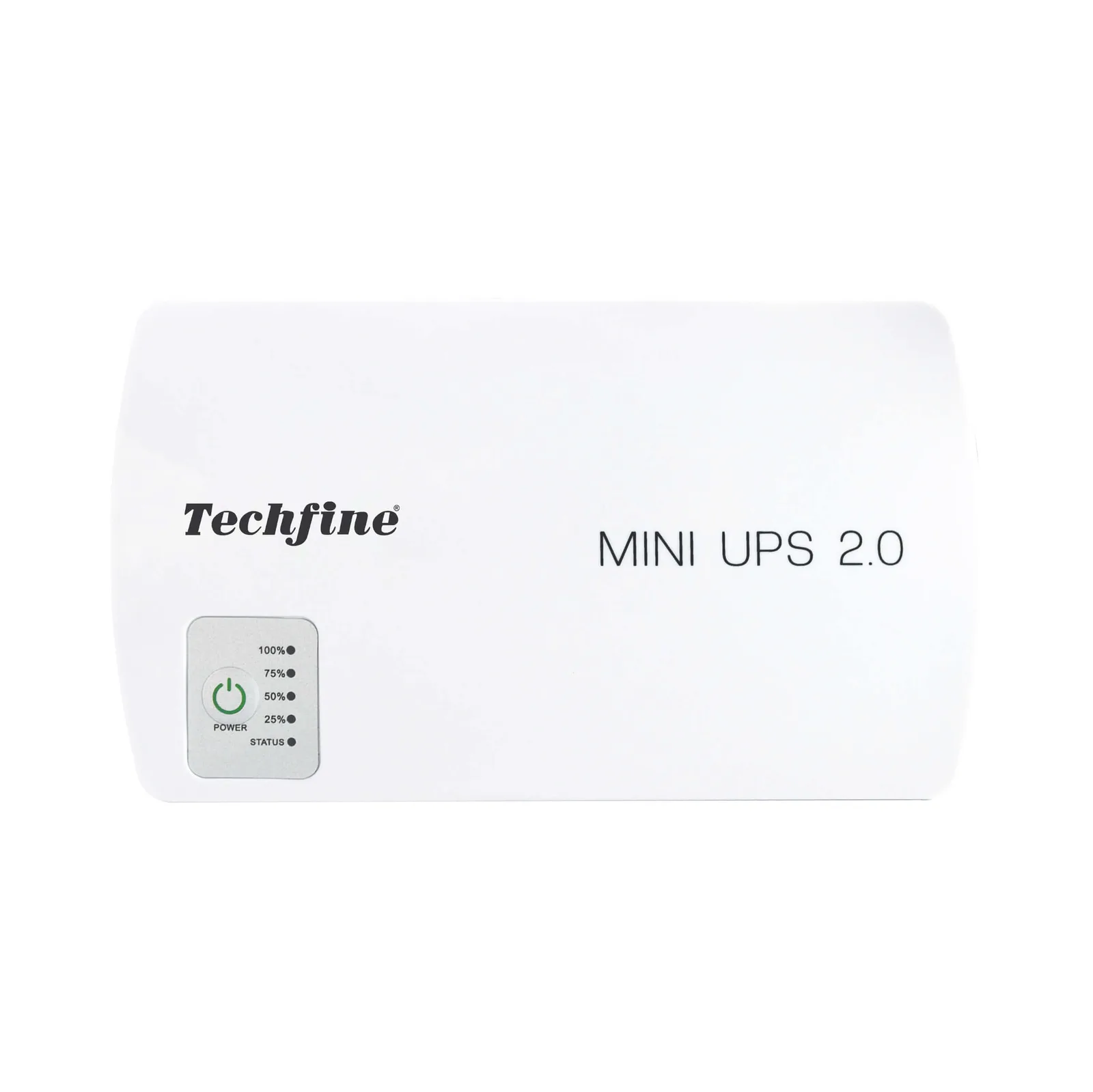
 Mini UPS
Review the displayed Techfine M18P mini UPS page
Map each device to an exact voltage, connector and PoE pinout, then confirm total load, battery/usable energy, runtime, plug, files, accessories and supply.
Mini UPSDisplayed M18P interfaces
Treat each voltage and connector as a separate compatibility check
One enclosure can expose several outputs, but the total power, per-port current, polarity and simultaneous-use rules govern the usable combination.
USB and 5 V DC
The table lists USB 5 V/2 A and a separate 5 V DC output. Confirm connector type, center polarity, cable loss, whether both may be used together and the total 18 W limit.
9 V and 12 V DC
Displayed ratings include 9 V/1 A and 12 V/1.3 A. Match the device voltage tolerance, barrel dimensions, polarity and startup/current behavior before connection.
15 V and 24 V PoE-labelled outputs
The table lists 0.6 A routes. Confirm passive or standards-based PoE behavior, pinout, data pass-through, connector wiring, voltage tolerance and target-device acceptance.
Four-cell lithium battery route
The source says four 18650 cells and conventional 2200 mAh with a customizable range. Request pack topology, nominal/usable Wh, cell model, BMS, cycle-test basis and replacement policy.
Mini UPS RFQ checks
Six checks before using the M18P with a router, camera or network device
A safe shortlist maps every port and cable to one named device and calculates autonomy from actual input power.
Device and outage objective
List router, modem, ONU, camera, access point or other load; provide required operating time, startup/reboot tolerance and whether multiple devices must remain powered together.
Voltage, current and polarity
Record each device's input label, normal/peak current, connector dimensions and center polarity; do not select only from a 5/9/12/15/24 V headline.
PoE and data path
Confirm passive or IEEE mode, pin pairs, data speed/pass-through, injector/splitter arrangement, cable length and the powered device's accepted voltage and current.
Total power and runtime
Sum simultaneous input watts, include conversion/cable losses and startup peaks, then confirm the 18 W shared limit, battery pack Wh, cutoff, temperature and runtime test at that load.
Input, plug and environment
Confirm destination mains voltage/frequency, plug/adapter, fuse, operating temperature, ventilation, mounting, enclosure and charging restriction; the table says charging is prohibited below 0°C.
Files and commercial scope
Request exact datasheet/manual, cell and pack identity, safety/EMC, UN38.3 test summary and SDS where applicable, warranty, accessories, packaging, quantity, sample and lead time.
Device and runtime boundaries
Multiple voltage labels do not make the M18P universal
Compatibility and autonomy depend on exact port wiring, device demand, battery pack, environment and evidence.
PoE wording needs a pinout and standard
A 15 V or 24 V PoE label does not prove IEEE 802.3 mode, negotiation, pin assignment or safe use with every camera, access point or router.
18 W is a shared power boundary
Do not add every port's maximum as though all outputs can deliver it simultaneously. Confirm the manufacturer's total-load rule and derating for the exact configuration.
mAh alone does not establish runtime
The source does not clearly turn its cell-capacity wording into pack usable Wh. Confirm cell topology, voltage, usable energy, cutoff, conversion efficiency, actual load and temperature.
0 ms and global wording are conditional
Confirm transfer behavior with the target device, plug and mains version, restart threshold, battery state and protection. Wide input voltage does not establish every regional approval.
Continue the mini UPS review
Connect device runtime to lithium-battery and delivery evidence
Use the sizing guide for the load/autonomy basis and the battery checklist for model-specific transport files.
Backup and battery sizing guide
Translate device watts and the autonomy target into a transparent usable-energy assumption instead of relying on a cell mAh headline.
Review runtime inputs
Lithium battery export checklist
Confirm the exact cell/pack, UN38.3 test summary, SDS, classification, packing, labels and traceability for the selected shipment.
Review battery files
Techfine mini UPS FAQ
Questions to close before connecting an M18P
These answers support procurement; the target device's label/manual and the exact M18P wiring remain decisive.
Can the Techfine M18P power any 5 V, 9 V or 12 V router?
No. Match voltage tolerance, normal and startup current, connector size, center polarity and cable loss. Also confirm the combined load stays within the exact unit's shared output limit.
Do the 15 V and 24 V PoE outputs work with every PoE device?
Do not assume so. Confirm passive or negotiated mode, pinout, data pass-through, cable and the target device's accepted PoE standard, voltage and power.
How long will the 2200 mAh mini UPS run?
A runtime cannot be derived responsibly from that headline alone. Confirm pack topology and usable Wh, actual device watts, simultaneous ports, conversion losses, cutoff, battery condition and temperature.
What should an M18P RFQ include?
Include each device model and input label, connector/polarity, PoE mode/pinout, simultaneous watts, autonomy target, destination plug, battery/export files, quantity, sample and delivery target.
Techfine mini UPS procurement
Techfine M18P 18 W Mini UPS for Router, Network and DC-Load RFQs
The current Mini UPS category contains one displayed M18P page. Its table lists an 18 W total output class, 85–265 VAC input, USB and DC 5 V, DC 9 V, DC 12 V, plus 15 V and 24 V PoE-labelled outputs, with four 18650 lithium cells and a conventional 2200 mAh wording. Those labels do not prove connector, polarity, PoE pinout/standard, device compatibility or runtime. Confirm every powered device, simultaneous port load, cable, battery configuration, transfer behavior, thermal environment, safety/transport files, regional plug and current order terms.
Prepare a Techfine M18P mini UPS RFQ
Send the device labels, connectors and PoE wiring, simultaneous load, runtime target, destination plug, lithium files, accessories, quantity and schedule.