
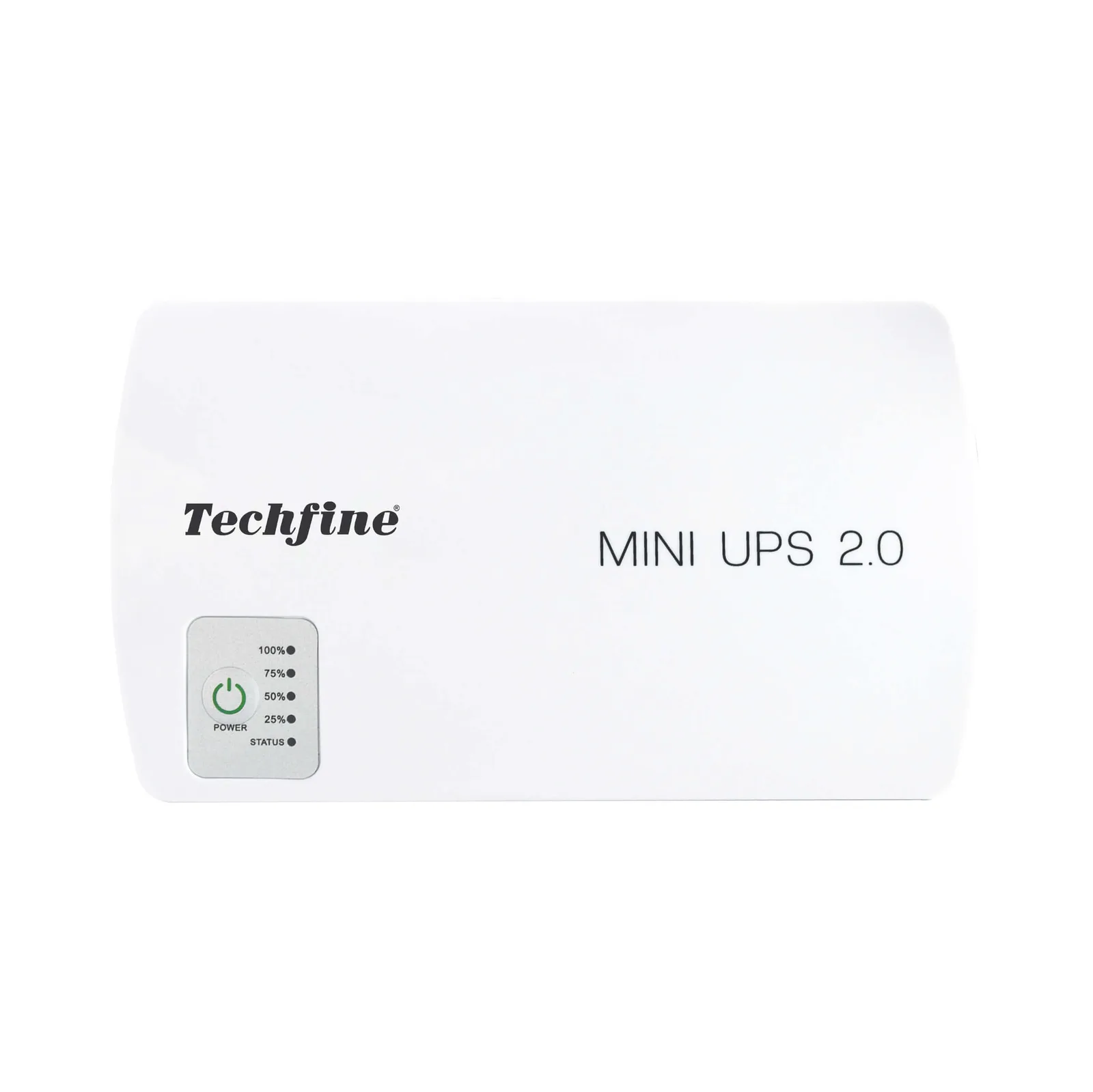
Techfine M18P 18 W Mini UPS for 5/9/12 V DC and PoE-Labelled Loads
The displayed M18P table describes an 18 W mini UPS with 85–265 VAC input, USB and DC 5 V outputs, 9 V and 12 V DC outputs, plus 15 V and 24 V PoE-labelled ports. It also lists four 18650 lithium cells and conventional 2200 mAh wording. Those values do not prove connector size, polarity, PoE standard or pinout, simultaneous port loading, usable pack energy or runtime for a particular router, ONU, camera or access point.
Original source record: Dc Mini Ups 12v 9v 5v Mini Ups Best Mini Ups for Router 18w.
Current source parameter table
This table is preserved from the current source record. Read it with the identity, compatibility and document boundaries below; unresolved conflicts are not corrected by assumption.
| Model | M18P | ||
|---|---|---|---|
| Output power | 18W | ||
| Input characteristics | |||
| Voltage range | 85~265VAC | ||
| Frequency range | 50Hz/ 60Hz | ||
| Surge current | ≤3A | ||
| Input fuse | 0.8A/250VAC | ||
| Output characteristics | |||
| Port | Voltage error | Ripple voltage | Rated current |
| USB5V | ±5% | ≤250mVp-p | 2A |
| DC5V | 2A | ||
| DC9V | ≤680mVp-p | 1A | |
| DCI2V | ≤900mVp-p | 1.3A | |
| POE15V | ≤1000mVp-p | 0.6A | |
| POE 24V | ≤1500mVp-p | 0.6A | |
| Conversion time | 0ms | ||
| Efficiency | |||
| Efficiency | ≥85% | ||
| Battery | |||
| Battery | Specification | Conventional 2200mAH(1800-2600mAH can be customized) (18650 lithium battery) | |
| Quantity | 4 | ||
| Appearance | |||
| LED display | Power display, working status display | ||
| Dimension | |||
| According to the normal standard configuration | Host | Dimension: L*W*H | 187*107*37(mm³) |
| Net Weight(KG) | 0.4 | ||
| Single unit packaging | Dimension: L*W*H | 200*164*40(mm³) | |
| Gross Weight(KG) | 0.54 | ||
| One box (20 units) | Dimension: L*W*H | 430*350*220(mm³) | |
| Gross Weight(KG) | ≈11.6 | ||
| Operation Environment | |||
| Operating temperature | 0°C~45°C (Typical value): 25 ℃(charging prohibited below 0℃) | ||
| Storage temperature | -10°C~70°C (Typical value):25°C | ||
| Relative humidity | (Relative humidity) 0~85 % (no condensation) | ||
| Altitude | ≤3000m | ||
| Heat dissipation method | Natural convection | ||
Current document status
The current source record contains an embedded M18P table but no downloadable manual, wiring sheet or battery document. Request the current connector/polarity diagram, PoE pinout, pack specification, UN38.3 test summary and SDS where applicable.
Current M18P table
Map every output to one device instead of relying on a multi-voltage headline
The table provides a starting point, but simultaneous-use and wiring rules remain confirmation items.
18 W total product class
The source identifies model M18P and 18 W output power. Confirm whether 18 W is the shared continuous limit across all ports and whether temperature derating applies.
USB and DC outputs
Displayed routes include USB 5 V/2 A, DC 5 V/2 A, DC 9 V/1 A and DC 12 V/1.3 A. Verify barrel size, center polarity, cable and device tolerance.
PoE-labelled outputs
The source lists 15 V/0.6 A and 24 V/0.6 A. Confirm passive or negotiated PoE, pin pairs, data pass-through, connector wiring and target-device acceptance.
Four-cell lithium wording
Four 18650 cells and 2200 mAh are displayed, with a customizable cell-capacity range. Confirm pack topology, nominal/usable Wh, cell model, BMS, cutoff and replacement policy.
M18P RFQ checks
Six checks before connecting a router, ONU, camera or access point
A safe request names each device, port and cable, then calculates autonomy from actual watts.
Target devices
List every device model, input-label voltage/current, normal and startup demand, reboot tolerance and the required outage operating time.
Connector and polarity
Confirm USB type, DC barrel outer/inner dimensions, center polarity, supplied adapter cables and whether splitters or converters are permitted.
PoE mode and pinout
Confirm passive or IEEE mode, voltage negotiation, powered pairs, data pairs/pass-through, speed, cable length and device power acceptance.
Combined load
Add simultaneous input watts and startup peaks, include cable/conversion losses and confirm the shared 18 W rule rather than summing every port maximum.
Battery and runtime
Request pack topology and usable Wh, BMS/cutoff, runtime at the actual combined load, cell identity, cycle-test conditions and operation/charging temperature limits.
Regional and order evidence
Confirm mains plug, input version, safety/EMC, lithium transport files, packaging, accessories, warranty, quantity, sample, lead time and substitution rules.
Compatibility and autonomy boundaries
5/9/12/15/24 V labels do not make the M18P universal
Electrical compatibility depends on the target device, connector, wiring, shared power and battery condition.
PoE requires more than voltage
A 15 V or 24 V label does not prove IEEE 802.3 support, negotiation, pin assignment, data compatibility or safe use with every PoE device.
Per-port values do not add to simultaneous power
Confirm the product's shared load and derating rules. Do not assume all listed ports can deliver their individual maximum at the same time.
mAh is not pack runtime
Cell-capacity wording does not establish pack usable Wh. Runtime also changes with actual watts, conversion loss, cutoff, battery age and temperature.
0 ms needs a device test
The table's 0 ms line does not prove every router or camera will avoid rebooting. Verify voltage stability, battery state, cable loss and the target device's ride-through behavior.
Continue the M18P review
Connect device runtime to battery evidence and shipping documents
Use the sizing guide for usable-energy assumptions and the export checklist for the exact lithium pack.
Battery and backup sizing guide
Translate the actual combined device watts and autonomy target into an explicit usable-energy basis.
Review runtime inputs →Lithium battery export checklist
Confirm exact cell/pack identity, UN38.3 test summary, SDS, classification, packing, labels and traceability.
Review battery files →Techfine M18P FAQ
Questions to close before connecting network equipment
The target device label/manual and the final M18P wiring sheet remain decisive.
Can the M18P power any 5 V, 9 V or 12 V router?
No. Match voltage tolerance, normal/startup current, connector dimensions, center polarity and cable loss, then confirm the combined load remains within the shared product limit.
Do its 15 V and 24 V ports support every PoE device?
Do not assume so. Confirm passive or negotiated mode, pinout, data pass-through, cable arrangement and the target device's accepted PoE standard, voltage and power.
Can runtime be calculated from 2200 mAh?
Not reliably from that line alone. Confirm pack topology, nominal and usable Wh, actual device watts, simultaneous ports, cutoff, conversion loss, battery condition and temperature.
Which documents should accompany an M18P RFQ?
Request the current datasheet/manual, connector and PoE wiring, cell/pack specification, UN38.3 test summary and SDS where applicable, safety/EMC evidence, warranty, accessories and packing.
Prepare a Techfine M18P device-matching RFQ
Send every device label, connector and polarity, PoE mode/pinout, simultaneous watts, runtime target, destination plug and lithium document requirements.
Match M18P to Devices