
Can an 8kW hybrid solar system run three air conditioners in Pakistan?
An 8kW label cannot tell you how three air conditioners will behave through a hot afternoon or a full night. Here is a practical way to check the quote.
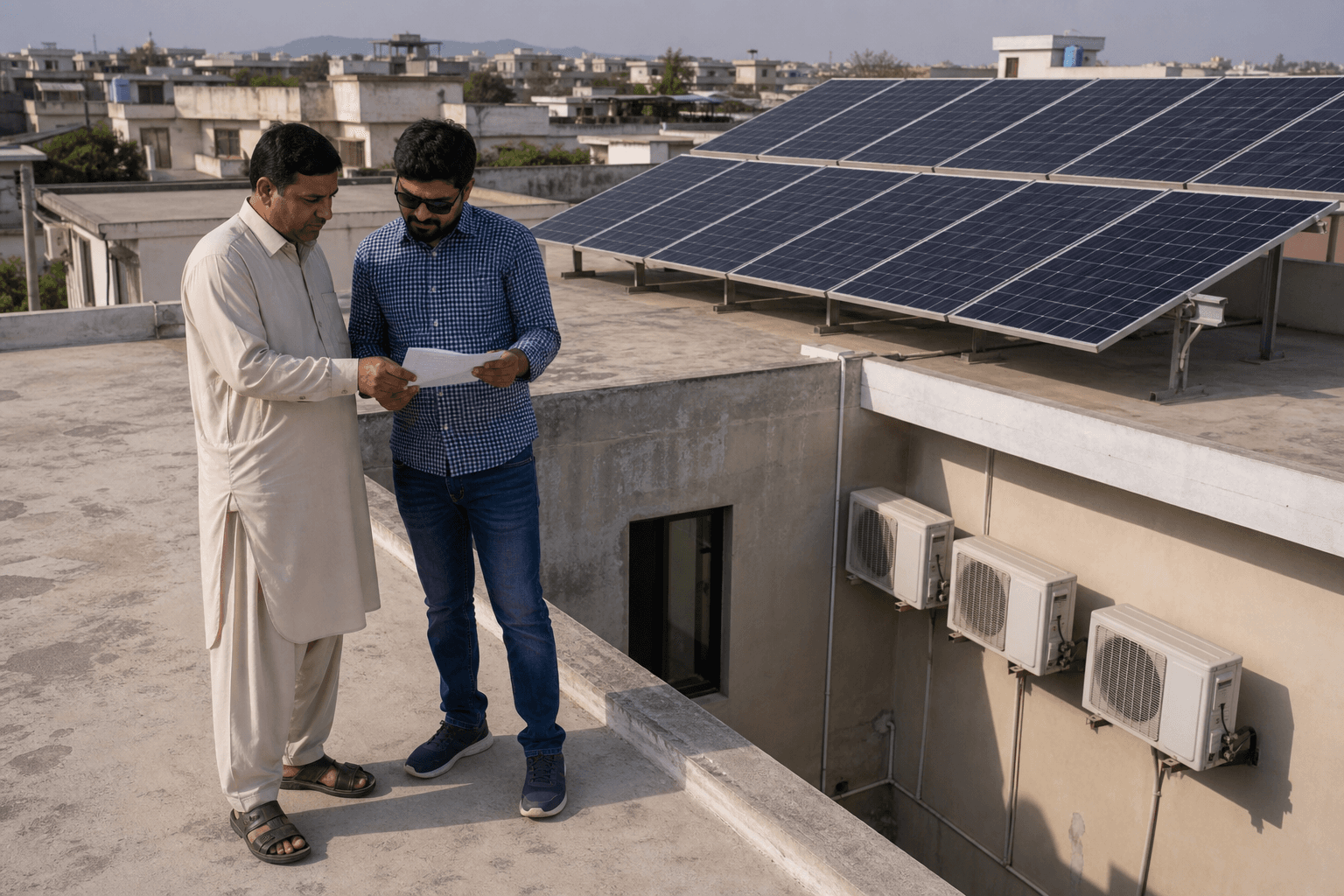
Yes, an 8kW hybrid solar system may run three efficient one-ton inverter air conditioners during a sunny part of the day. That does not mean it will run all three at every moment, or keep two of them going all night. The number on the inverter is only one part of the answer.
Air conditioners do not use one fixed amount of electricity. A unit may settle down after the room becomes cool, then work much harder when doors open, the afternoon temperature rises or the thermostat is turned lower. A setting such as 50% gear is useful for the owner, but it is not reliable proof that the unit will always draw half of its rated power.
This guide is for a household in Pakistan trying to make sense of an 8kW hybrid solar quotation. It explains what to check before choosing the inverter, panels and battery, especially when night-time cooling and zero-export operation are part of the plan. The figures below are teaching examples, not promised performance. The photographs are illustrative editorial scenes rather than customer project records.

Three air conditioners are not one fixed load
Start with the outdoor-unit label for each air conditioner. The familiar one-ton figure describes cooling capacity; it does not tell you the electrical input by itself. Two one-ton units from different product lines can behave differently, and the same unit can draw very different power in a cool room and a hot room.
Write down the exact model, rated electrical input and maximum input shown by the manufacturer. If a trustworthy energy monitor is already available, record what the unit draws on a genuinely hot afternoon and after the room has cooled. Do not work on a live panel or improvise a measurement. Use a suitable installed monitor or ask a qualified local professional.
Then add the other appliances that may be on at the same time. A refrigerator, water pump, iron, kettle or microwave can matter more than a few lights. A better question is: ‘What is the highest believable group of loads that this home will use together?’
- Exact model and electrical-input data for every air conditioner.
- Which units may run together during the hottest part of the day.
- Which units are expected to run after sunset or during a power cut.
- Other loads that can overlap, especially a pump, refrigerator, kettle, iron or cooking appliance.
- A safe, representative measurement from hot-weather use where reliable monitoring is available.
Does 50% mode mean an air conditioner always uses half its rated power?
No. It may limit the unit in a model-specific way, but room temperature, outdoor heat, insulation, set point and compressor operation still change the actual demand. Use the exact product data and a representative measurement where possible.
Four numbers tell four different parts of the story
Solar quotations often place several large numbers beside one another, which makes them look interchangeable. They are not. Read each one as an answer to a different household question.
- Number on the quote
- 8kW inverter
- What it helps answer
- How much AC power the inverter may supply at one time, subject to its operating mode and limits.
- What it cannot answer alone
- How many hours the battery will last.
- Number on the quote
- 8kWp solar array
- What it helps answer
- The combined nameplate rating of the panels under test conditions.
- What it cannot answer alone
- The exact power available throughout a real Islamabad day.
- Number on the quote
- 10kWh battery
- What it helps answer
- Roughly how much energy the battery is designed to store before usable-energy and reserve limits are checked.
- What it cannot answer alone
- Whether it can start or run every chosen appliance together.
- Number on the quote
- Backup output
- What it helps answer
- What the inverter may supply to selected backup circuits when the grid is unavailable.
- What it cannot answer alone
- Whether the whole house is automatically backed up.
| Number on the quote | What it helps answer | What it cannot answer alone |
|---|---|---|
| 8kW inverter | How much AC power the inverter may supply at one time, subject to its operating mode and limits. | How many hours the battery will last. |
| 8kWp solar array | The combined nameplate rating of the panels under test conditions. | The exact power available throughout a real Islamabad day. |
| 10kWh battery | Roughly how much energy the battery is designed to store before usable-energy and reserve limits are checked. | Whether it can start or run every chosen appliance together. |
| Backup output | What the inverter may supply to selected backup circuits when the grid is unavailable. | Whether the whole house is automatically backed up. |
The exact datasheets and final operating settings decide the real limits; package names do not.
Daytime cooling and night-time cooling are different jobs
At midday, the panels can supply the house while sunlight is available. If production is higher than the household load, the remaining energy can charge the battery. If clouds pass, the panels become hot, or dust and shade reduce output, the inverter may need help from the battery or grid. An 8kW array does not sit at 8kW from morning to evening; daily production rises, peaks and falls.
After sunset, the panels contribute nothing. The battery must carry the selected loads, and its stored energy becomes the main limit. That is why three air conditioners for a few sunny hours and two air conditioners for a whole summer night are separate design questions.
A grid failure adds another boundary. Some hybrid inverters can supply only named backup circuits when the grid is down. The power available from that backup output may differ from the headline grid-connected rating. Ask the seller to state in writing which circuits are backed up, the continuous output available in backup mode and whether the proposed battery can support that output.
- Expected solar production while the air conditioners are running.
- Power left for battery charging after the daytime household load is served.
- Loads connected to the backup output rather than the whole house by assumption.
- Continuous backup output and any model-specific limits when operating from the battery.
A simple way to estimate the night-time battery job
Here is a made-up example. Suppose two inverter air conditioners average 550W each across an evening, and the refrigerator, fan, lights and internet equipment average another 250W. The combined average is 1.35kW. Over six hours, those appliances use about 8.1kWh: 1.35 multiplied by 6.
That does not mean a battery carrying a 10kWh label will finish the job with 1.9kWh to spare. The stated capacity may be nominal rather than usable. The system may keep a reserve instead of emptying the battery, and some energy is lost while DC electricity is converted for household appliances. The air conditioners may also work harder than the assumed average on a hotter night.
The example is useful because it shows how quickly night-time cooling uses energy. Replace every figure with the real home's data. Check usable energy in the exact battery datasheet, the reserve setting, the inverter's own consumption and the continuous discharge power allowed by the battery and its control system. Finally, ask whether the panels can recharge the battery on an ordinary day while still running the daytime loads.
- Average night load in kW, based on real appliances rather than room count.
- Required hours of cooling and the loads that must remain on for the full period.
- Usable battery energy in kWh after the intended reserve is kept.
- Continuous battery discharge power, which is separate from stored energy.
- A realistic next-day recharge plan for summer, cloudy weather and normal household use.
What battery size should be paired with an 8kW solar system?
There is no fixed battery size for an 8kW inverter. Estimate the energy used by the chosen night or outage loads, then compare it with usable battery energy, reserve, conversion losses, discharge power and the available recharge window.
Choosing 6kW, 8kW or 10kW without guessing
A home's average load can be low while its short busy period is much higher. Three air conditioners may be settled, then a pump or kitchen appliance starts. That overlap is what the inverter must handle. The decision should also account for the exact inverter's high-temperature limits and its output in battery or backup mode.
Moving from 6kW to 8kW can provide useful room when the measured peak, backup plan or near-term expansion supports it. Jumping to 10kW or 12kW simply because it sounds safer is not a complete answer. A larger inverter does not add battery energy, create more roof space or fix an incompatible battery. It can also change the battery, PV-input and installation requirements.
Ask each seller to show the same load case. Include the air conditioners, ordinary background loads and the few demanding appliances that might overlap. Then compare the model's continuous output, backup output, operating-temperature information, PV limits and approved battery options. This turns a size recommendation into something that can be checked.
- What exact simultaneous load was used to choose the inverter size?
- Does the quoted output apply on grid, during backup, or in both conditions?
- What changes in the battery or panel design if a larger inverter is selected?
- Which future appliance is actually expected, and when is it likely to be added?
Is a 10kW inverter automatically better than an 8kW inverter?
No. It may be useful for a larger verified peak or future load, but it does not make an undersized battery last longer or make an unsuitable panel string correct. Compare the complete system around the real load.
Panel wattage is not the same as useful solar energy
A roof carrying about 8kWp of panels will not deliver exactly 8kW all day. Morning and late-afternoon sun are weaker. Hot modules normally produce less power than their nameplate test figure, while clouds, dust, shade, orientation and seasonal weather change the curve again. What matters is the energy available across the hours when the home is cooling rooms and charging the battery.
The largest panel wattage in the market is not automatically the best choice. A higher-wattage module is usually physically larger and may have different current and voltage values. Fourteen smaller modules may fit a roof or inverter differently from fewer larger modules. The exact panel model, quantity, roof layout and inverter input limits need to be checked together.
An elevated rooftop frame deserves its own review. Raising modules can leave usable space below, but the structure also catches more wind. Hot-dip galvanizing addresses corrosion; it does not prove that the frame, anchors or building can carry the wind and structural loads. A qualified local structural party should approve the final arrangement for the actual house and location.
- Panel model, quantity and total array size in kWp.
- Roof dimensions, shade, orientation and space needed for safe access.
- Manufacturer input limits for the exact inverter and the proposed panel arrangement.
- Structural design responsibility for an elevated frame, including wind at the site.
Check the inverter and battery as a pair
A battery and inverter can both be good products and still be the wrong pair. Compatibility depends on the exact model codes, voltage range, communication method, firmware, permitted number of battery modules and any required control equipment. A family name or a dealer's verbal assurance is not enough. Ask for the current manufacturer compatibility document covering the offered models.
Low-voltage and high-voltage batteries also belong to different system routes. For the same power, a higher battery voltage can mean lower current. It does not mean there is no heat or energy loss, and it does not make every high-voltage battery compatible with every high-voltage inverter. The installer must follow the approved equipment combination and the manufacturer instructions.
Capacity can be confusing here too. Some product pages show nominal energy, usable energy and charge or discharge current as separate lines. Read all of them. Two battery modules may increase the stored energy while another system limit still caps the available power. If future expansion matters, confirm the permitted module count, age-matching rules and expansion process before buying the first battery.
- Full inverter and battery model codes rather than brand and series names alone.
- Manufacturer compatibility evidence for the offered combination.
- Nominal energy, usable energy and continuous charge/discharge limits.
- Required communication hardware, firmware and accessories.
- Approved expansion method and the limits that apply to adding batteries later.
What zero export changes—and what it does not
Zero export usually means the system measures power at the grid connection and controls the inverter so that little or no solar energy is intentionally sent back through the utility meter. The home can still use solar directly and charge its battery. Once the battery is full and the household load falls, the inverter may have to reduce solar production because there is nowhere else for that energy to go.
This arrangement should not be confused with an off-grid home. If the system remains connected to the utility, its behaviour during a grid failure depends on the inverter, backup equipment and final electrical design. Zero export by itself does not promise that the house will keep running when IESCO power is unavailable.
Pakistan's current prosumer framework has changed from the older net-metering rules. NEPRA's 2026 regulations describe net billing for eligible interconnected prosumers, and amendments have followed. Before deciding that zero export avoids every application or metering requirement, ask IESCO and the qualified local installer what applies to the exact connection. Compare that answer with the value of afternoon surplus, battery charging needs and the owner's willingness to shift loads into sunny hours.
- The meter or control device used for zero-export measurement and the promised control behaviour.
- What the system does when the battery is full and household demand is low.
- Which loads remain available when the grid fails.
- Current IESCO and NEPRA requirements for the proposed grid connection.
- A comparison based on self-consumption and current rules, not an old export tariff or sales claim.
Does zero export make a hybrid solar system independent from the grid?
No. Zero export controls energy sent toward the grid. Backup during an outage is a separate function, and local connection or safety requirements may still apply to a grid-connected system.
A useful 8kW quotation should answer these questions
A quotation becomes easier to trust when its assumptions are visible. It should name the equipment, show how the load was estimated and separate sunny-day operation from night-time or outage operation. Avoid comparing two package prices until both sellers are solving the same job.
Start with the air-conditioner labels and the hours that matter. Put those loads into a simple calculator, then add the refrigerator, fans, pump and the few appliances that may overlap. Send the same list to every supplier. The result will still need site design and local approval, but the conversation will be based on the home rather than a package name.
- Exact panel, inverter and battery models, quantities and current datasheets.
- The load list and operating hours used for daytime and night-time calculations.
- Expected backup circuits, continuous backup output and battery runtime assumptions.
- Nominal and usable battery energy, reserve, power limits and recharge assumptions.
- Zero-export scope, monitoring equipment and expected behaviour when solar is greater than the load.
- Named responsibility for roof structure, electrical design, protection, approval, installation and commissioning.
Related Articles
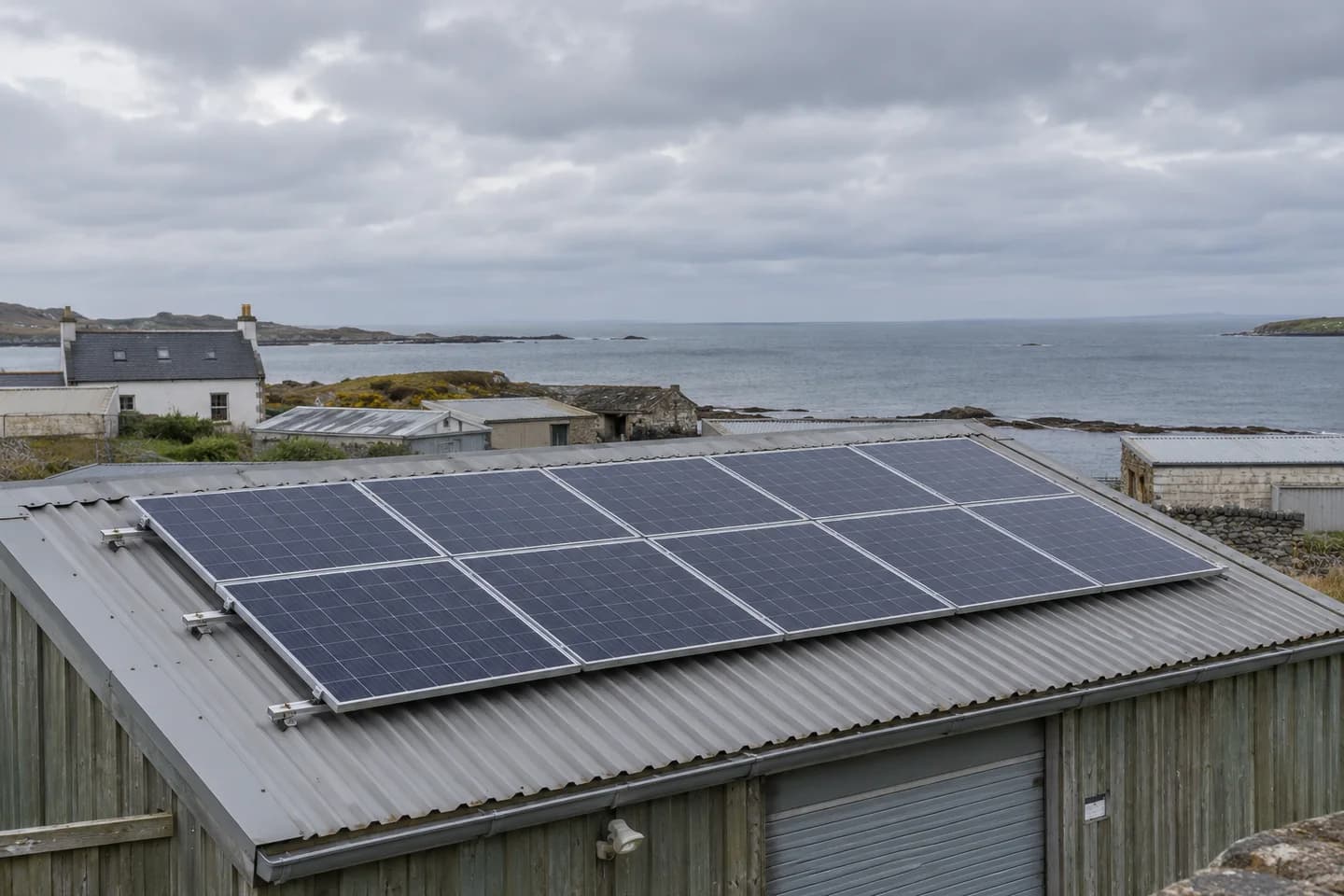
How do solar panels perform in clouds, heat, salt air and dust?
A panel's watt rating cannot describe every site. Learn what changes in cloudy, hot, coastal and dusty locations, and which details belong in a supply quote.
Read Article→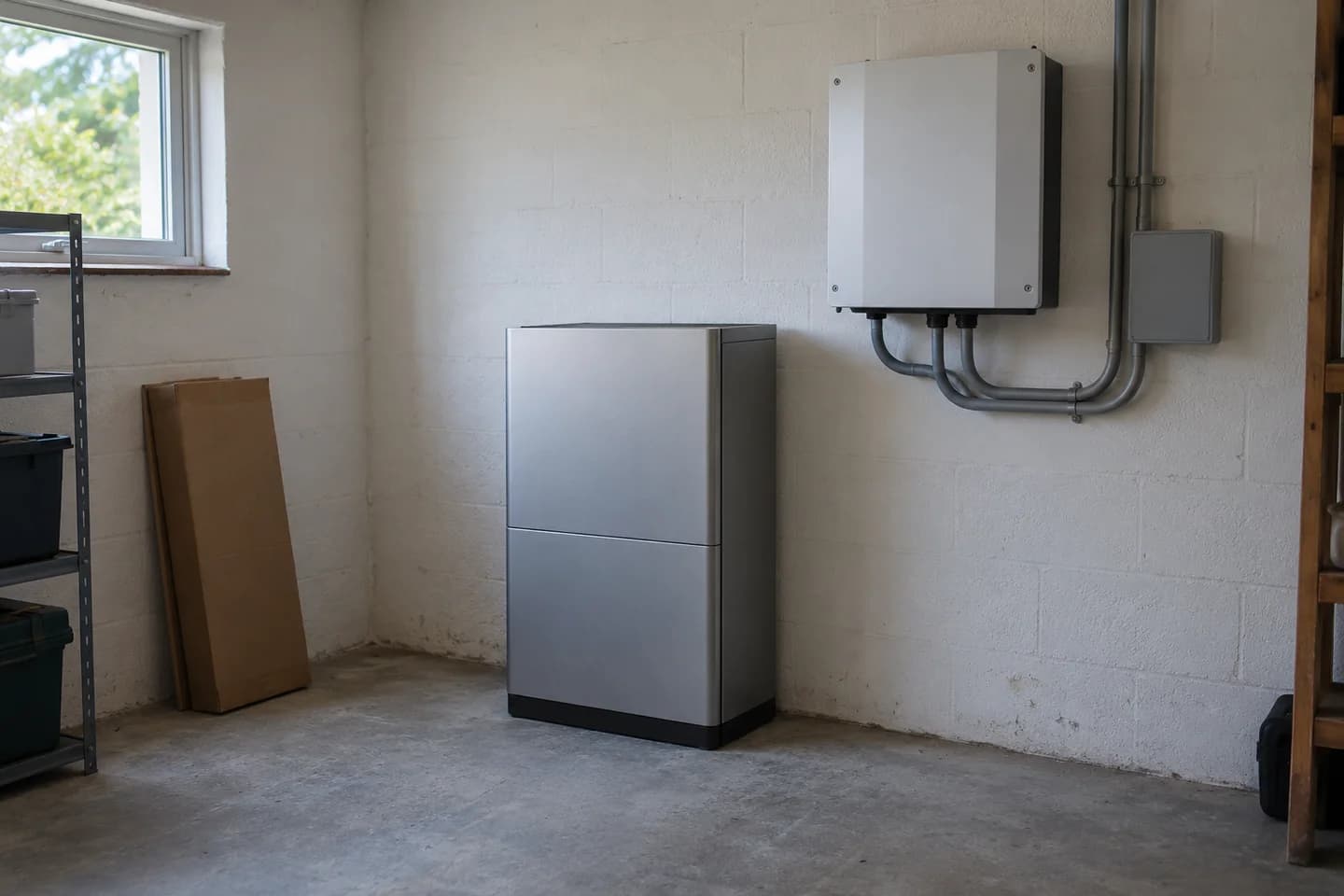
How to compare solar battery specifications before buying
Two batteries with the same kWh label can do different jobs. Here is how to read the numbers, check the missing details and compare like-for-like quotes.
Read Article→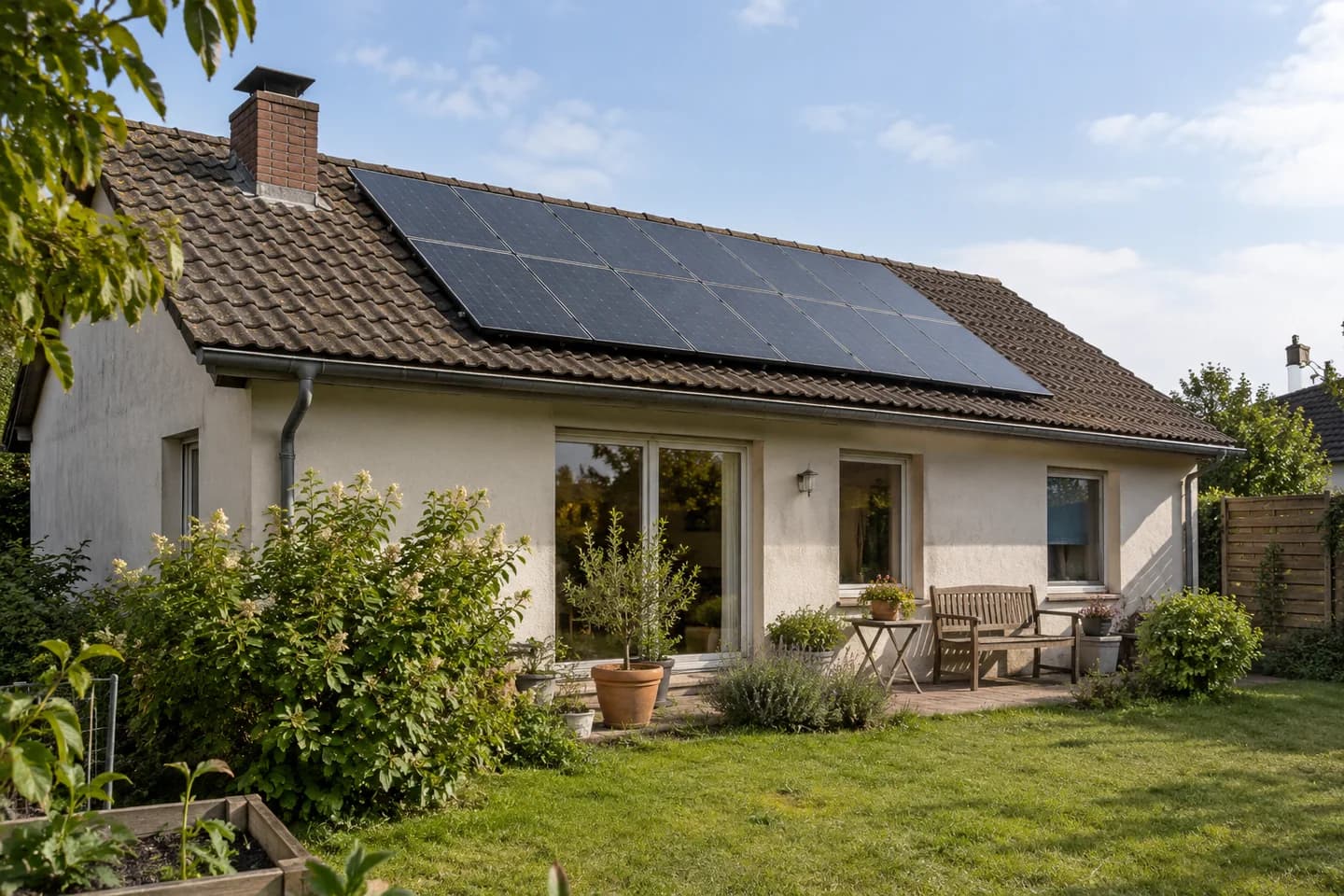
Solar self-consumption and grid export: what equipment do you need?
For project buyers, installers and distributors: what to source as an equipment package, what to arrange locally, and what a useful supply quote should include.
Read Article→