
How to compare solar battery specifications before buying
Two batteries with the same kWh label can do different jobs. Here is how to read the numbers, check the missing details and compare like-for-like quotes.
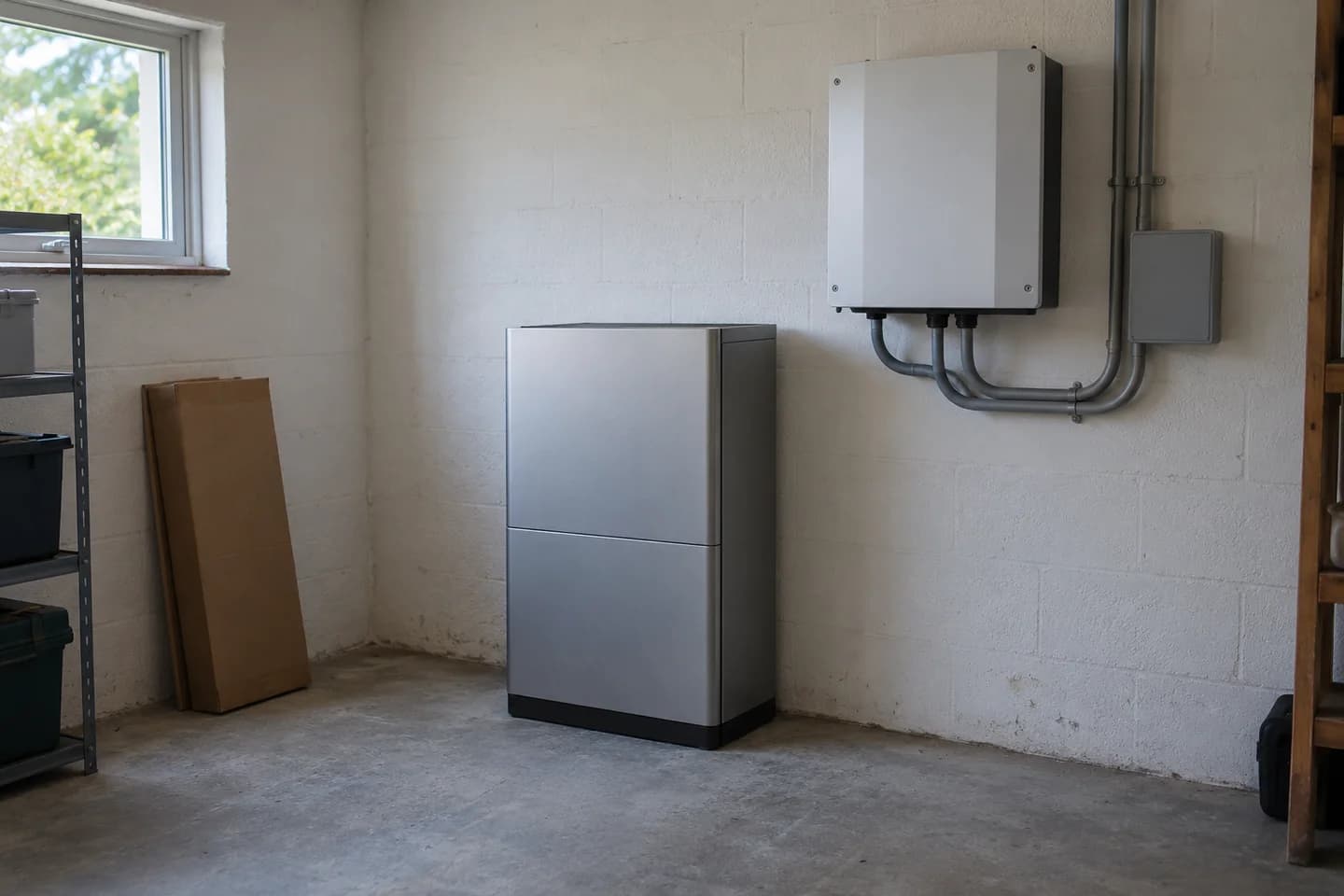
Two quotes arrive, both offering a 10 kWh solar battery. One costs less. Does that make it the better buy? Perhaps, but first check whether you are looking at the same amount of usable storage, the same power output and the same equipment package.
For a useful solar battery comparison, put usable capacity, continuous charging and discharging power, inverter compatibility and warranty terms side by side. Efficiency, temperature limits, expansion rules and included parts help explain the remaining differences in price. The case design or one large cycle-life number cannot answer those questions.
This guide is for buyers choosing finished batteries for homes and small commercial projects, including installers and distributors checking supplier offers. Keep the full model codes beside the numbers. A standalone battery pack and an all-in-one inverter-and-battery unit need different supply lists.
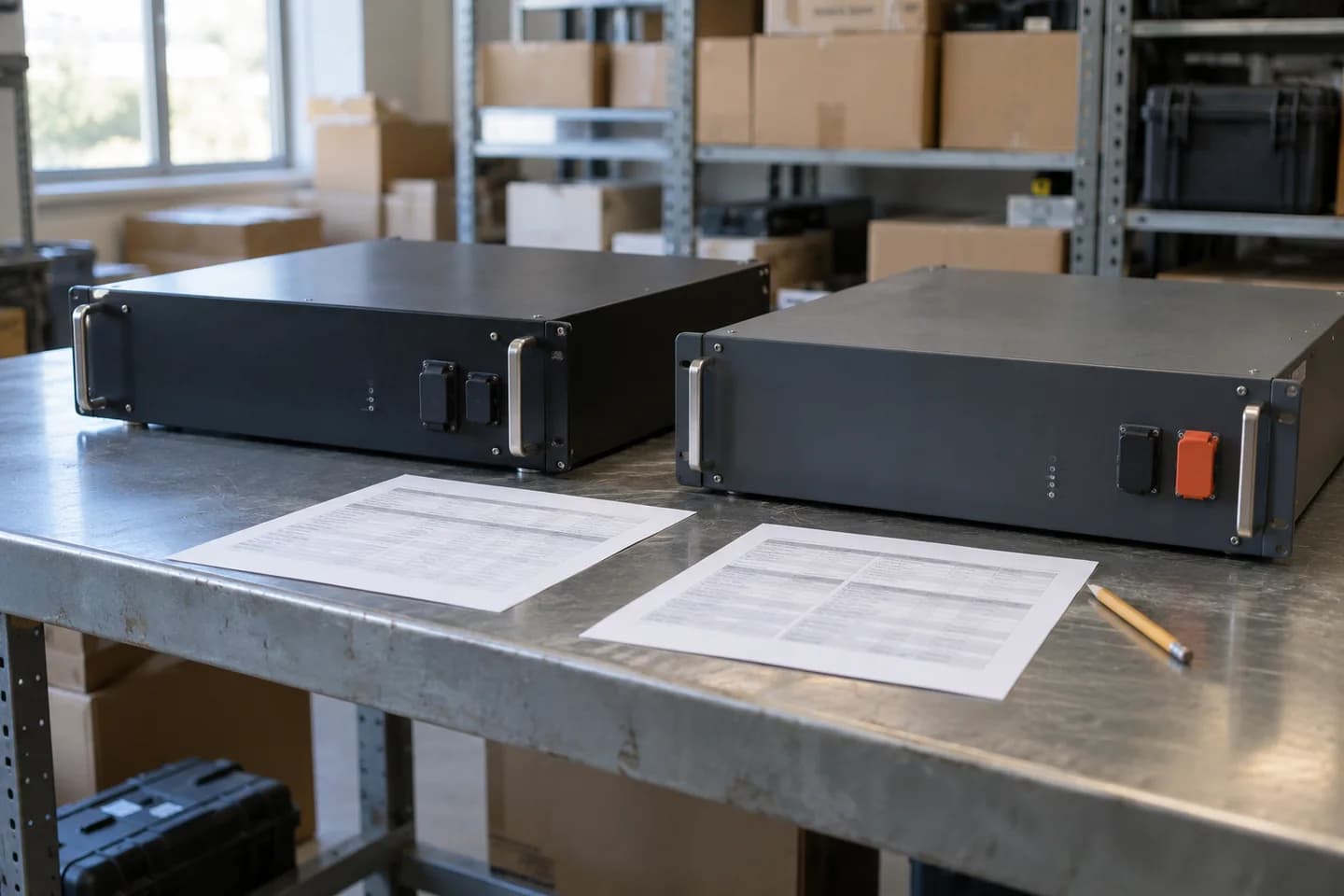
Usable capacity and power: what will it actually run?
Capacity in kilowatt-hours, or kWh, tells you how much energy is stored. Power in kilowatts, or kW, tells you how fast the system can supply it. A bigger energy store can run a modest load for longer without necessarily running more appliances at once. The Department of Energy distinguishes these two ratings in its storage guidance.
Nominal and usable capacity are two different lines on a specification sheet. Nominal capacity is the battery's rated energy; usable capacity is the amount available within the manufacturer's specified operating limits. There is one more detail: a figure measured at the battery's DC terminals is not the same as energy delivered at the AC output after conversion. Both offers need to use the same measurement point.
Depth of discharge, often shortened to DoD, describes how much of the battery's capacity is used. If the quoted usable energy already includes that limit, multiplying by DoD again applies it twice. Charge held back for power cuts can also leave less energy for routine evening use. That is a setting to discuss with the supplier, not a change in the battery's nameplate capacity.
An Ah figure needs its voltage. For example, 51.2 V × 100 Ah ÷ 1,000 gives 5.12 kWh of nominal energy. That arithmetic does not establish usable energy, AC output or compatibility. Comparing only 100 Ah with 200 Ah across different voltages can be misleading.
“Can I run these appliances together during a power cut?” needs a continuous-power answer. Peak power is a short-duration rating, so its duration and conditions matter. A motor may need more power to start than to keep running. With a separate battery and inverter, the supplier should state what the pair can deliver together; the inverter's front-label rating alone is not enough.
The following made-up offers illustrate the difference. At a steady 4 kW AC load during a power cut, with no solar contribution, Package A cannot sustain that load. Package B clears the running-power check, but motor starting and the supported backup circuits still need confirmation. If your loads stay well below 3 kW, the extra output may offer little benefit.
- Quoted item
- Nominal battery energy
- Package A
- 10 kWh
- Package B
- 10 kWh
- Quoted item
- Usable energy at battery DC terminals
- Package A
- 9 kWh
- Package B
- 9 kWh
- Quoted item
- Supported continuous AC backup output, battery only
- Package A
- 3 kW
- Package B
- 5 kW
- Quoted item
- Maximum continuous charging power into the battery
- Package A
- 2 kW
- Package B
- 4 kW
| Quoted item | Package A | Package B |
|---|---|---|
| Nominal battery energy | 10 kWh | 10 kWh |
| Usable energy at battery DC terminals | 9 kWh | 9 kWh |
| Supported continuous AC backup output, battery only | 3 kW | 5 kW |
| Maximum continuous charging power into the battery | 2 kW | 4 kW |
Illustrative packages, not products or test results. Assume new batteries at 25°C with the specified compatible inverter. DC energy and AC output are labeled separately; losses, reserve settings and real operating conditions still affect use.
Will it recharge in time, and work with your inverter?
Suppose you have only a few hours of spare solar after the site's daytime use. How much can the battery take in during that time? The same question applies to a short lower-price grid-charging period. Enough storage for the evening does not help much if the charging window ends before it has been filled.
Using the illustrative packages above, putting 8 kWh into the battery would take four hours at a steady 2 kW, or two hours at a steady 4 kW. These are ideal calculations at the battery input, not promised charging times. Available solar after site loads, conversion losses, charging limits near full charge and temperature can lengthen the process. Package B's higher limit helps only when the charging source and inverter can supply it.
A sheet listing amperes, marked A, or a C-rate takes an extra step to interpret. The supplier can express those limits as continuous charging and discharging power for the quoted battery configuration. The recommended operating rating may differ from the maximum. The proposed system should have a clear rating you can compare, without choosing whichever number looks largest.
For compatibility, the question is specific: “Will this battery model work with this inverter model, in the number of modules I am buying?” The answer needs their operating-voltage ranges and, where they communicate, the supported protocol, software versions and accessories. The battery management system, or BMS, monitors the battery and sets charging and discharging limits. Two products both saying CAN or RS485 does not prove they understand each other.
Ask for the manufacturer's current pairing document or written model-specific confirmation. BYD's official document library, for example, publishes compatible-inverter lists separately from battery datasheets. For an all-in-one unit, check the integrated inverter's continuous AC rating, charging limits and backup output. A large built-in battery does not override a smaller inverter limit.
Read cycle life and warranty as separate promises
LiFePO4, also called LFP, identifies the battery chemistry. It does not tell you the quality of the finished pack, its usable output or the service you will receive. Compare the documented product, not the chemistry label alone.
A claim of 6,000 cycles is incomplete without its test conditions: depth of discharge, temperature, charge and discharge rate, and remaining capacity at the end of the test. Victron's Lithium Smart technical data, for example, gives different cycle counts for different depths of discharge and states a retained-capacity threshold. That makes a bare cycle count difficult to compare with another supplier's headline number.
Do not turn a cycle count into guaranteed years by dividing it by 365. That shortcut ignores the test conditions and how the battery will be used. It also says nothing about what happens if electronics or another part fails.
“Ten years” is only the headline of a warranty. The written terms explain when cover starts, which defects are covered and what performance is promised. They may also limit total energy delivered over the battery's life, called throughput. Some performance cover ends at a stated age or throughput, whichever comes first. The promised remaining-capacity percentage matters too; it does not mean the battery will stay as new.
BYD's linked warranty document illustrates this separation between product and performance cover. It is a specific product-and-market example, not a warranty for every battery. Request the version applicable to the exact model, purchase route and destination.
“If it fails, who do I contact, and who pays to put it right?” is worth asking before the order. The reply should identify the claim contact, required records, available remedy and responsibility for diagnosis, labor and shipping. Those details make the warranty easier to judge than its length alone.
Check the installation conditions and efficiency footnotes
The room or outdoor position belongs in the buying discussion. A sheltered storeroom, a hot garage and an exposed wall can put different demands on the battery. Charging and discharging may have separate temperature limits, and available power can fall under some conditions. Victron's Lithium Smart data shows separate temperature ranges for charging and discharging. The relevant limits are those for the model being quoted.
It also has to fit. Dimensions, weight, required clearance, enclosure rating and humidity conditions belong in the information given to the installer before shipment. An IP rating alone does not make every outdoor location suitable. Heating or cooling, where included, adds another energy demand to account for.
An efficiency percentage needs a description of what was measured. Battery-only DC efficiency cannot be directly ranked against a figure including charging, inverter conversion and AC delivery. Tesla's Powerwall 3 datasheet separately reports solar-to-home and solar-through-storage efficiency, with test-condition footnotes. The electricity takes a different path in each case.
As a simple efficiency example, if 10 kWh enters a defined storage path and 9 kWh comes back out through that same path, round-trip efficiency is 90%. Ask both suppliers to use the same boundary and disclose standby, controls and temperature-management consumption. Those extra loads matter particularly when the useful daily energy is small.
Compare the complete quote, including the expansion route
Once the energy, power and pairing checks fit the job, compare what arrives with each price. A battery-only offer may exclude the inverter, central controller, rack or base, communication parts and other required accessories. An all-in-one offer may include some of those items but still need separate equipment for the intended backup function.
Keep equipment, delivery and local installation costs on separate lines. Cost per usable kWh can help screen like-for-like equipment quotes: divide the same-scope equipment price by usable energy measured at the same point. It cannot tell you whether the system has enough power, a supported pairing or a workable service route.
“I will add another module later” needs an answer while the first package is being priced. Which modules will be supported, can older and newer units operate together, and will another controller or inverter be needed? Adding energy may leave power unchanged. Spare space in a rack does not settle any of those questions.
Ask for the exact-model safety and transport documents needed for the purchase, rather than accepting a general certificate for a cell or another product family. The responsible installer and project reviewer confirm site requirements and final design. Rongkai can coordinate the battery-and-inverter equipment quotation, model documents, included accessories and packing details.
These five details should be in the offer or its supporting documents. A missing answer remains an open item; it is not evidence that the part or service is included.
- Exact models and module quantities; nominal and usable energy with the measurement point stated.
- Supported continuous charge and discharge power, peak duration and output in the intended operating mode.
- Inverter pairing evidence, required software and accessories, plus the permitted later-expansion route.
- Applicable warranty, claim contact, retained-capacity or throughput conditions, and responsibility for service costs.
- Itemized equipment, model documents, packing and delivery terms, with installation and excluded items shown separately.
Is the battery with the most kWh always the best choice?
No. It must have enough usable energy for the intended hours, enough continuous power for the loads, and a charging path that can refill it. Compare larger capacity only after the pairing, installation conditions and complete cost are clear.
Does a bigger Ah rating mean a bigger solar battery?
Only when the voltage and comparison conditions are the same. Nominal volts multiplied by Ah and divided by 1,000 gives nominal kWh. For buying decisions, ask for the manufacturer's usable-energy figure as well as continuous power and inverter compatibility.
Related Articles
How do solar panels perform in clouds, heat, salt air and dust?
A panel's watt rating cannot describe every site. Learn what changes in cloudy, hot, coastal and dusty locations, and which details belong in a supply quote.
Read Article→
Solar self-consumption and grid export: what equipment do you need?
For project buyers, installers and distributors: what to source as an equipment package, what to arrange locally, and what a useful supply quote should include.
Read Article→
Can an ice factory run on solar and add batteries later?
Use solar to cover part of the daytime load, then add storage for the outages you need to cover. First, check what happens when the grid goes off.
Read Article→