
Battery and inverter compatibility checks before placing an order
Voltage alone is not a compatibility statement.
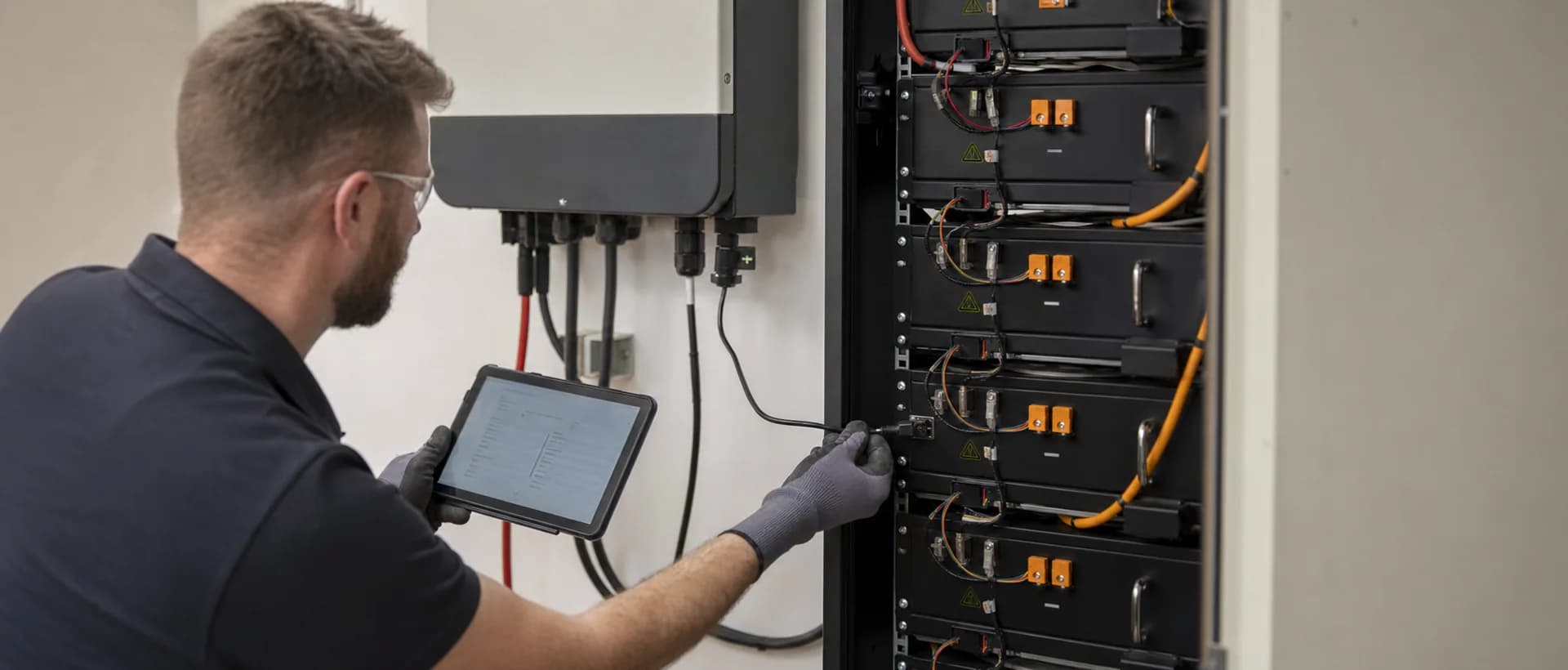
Check the exact inverter model, battery model, firmware status, BMS protocol, voltage class, charge and discharge limits, cable and protection requirements, and any approved-battery list. A compatible nominal voltage does not prove that a pairing is supported.
Put the confirmation into the order record. The RFQ should show the intended pairing, quantities, application, destination, and requested backup behavior. If a substitution is proposed, repeat the compatibility review rather than treating it as a commercial-only change.
Turn compatibility into a controlled order record
The most reliable evidence is a current, model-specific compatibility statement from the relevant product channel, supplemented by the installation documents for both products. A sales quotation or a shared voltage class is not the same evidence. Check whether the stated support depends on firmware, a particular battery count, accessory, cable length, or operating mode.
Compatibility also has a system boundary. The BMS link, battery breaker, cable size, earthing arrangement, CT or meter, backup-load panel, and commissioning sequence may all affect whether a proposed configuration can be put into service. Do not replace an approved model late in the process without rechecking those boundaries.
- Write the complete inverter and battery model identifiers, including revisions where they are used.
- Obtain the current approved-pairing evidence and record its date or version.
- Check voltage range, maximum charge/discharge current, battery quantity, and usable-power limit together.
- Confirm BMS protocol, communications cable or accessory, and firmware or commissioning requirements.
- Record the planned backup loads and protection arrangement; route final electrical design to a qualified professional.
Does an inverter's battery-voltage range prove it will work?
No. It only confirms one electrical boundary. The exact BMS communication, charge/discharge control, firmware, accessories, and approved pairing still need confirmation.
What to do when a substitution is proposed
Treat a proposed replacement battery or inverter as a configuration change, even when its headline power or voltage is similar. Recheck the approved pairing, BMS protocol, firmware, current limits, required accessories, documents, and the project’s backup objective. Update the RFQ or order record so the customer can see exactly what has changed.
Do not allow a logistics or stock decision to bypass that review. A clear substitution procedure protects both the buyer and every downstream party who will design, install, commission, or support the system.
Who should approve a changed pairing?
The responsible technical party and the customer should approve it based on current model-specific compatibility evidence. Procurement can coordinate the record but should not treat a stock substitution as an automatic equivalent.
Related Articles

How do solar panels perform in clouds, heat, salt air and dust?
A panel's watt rating cannot describe every site. Learn what changes in cloudy, hot, coastal and dusty locations, and which details belong in a supply quote.
Read Article→
How to compare solar battery specifications before buying
Two batteries with the same kWh label can do different jobs. Here is how to read the numbers, check the missing details and compare like-for-like quotes.
Read Article→
Solar self-consumption and grid export: what equipment do you need?
For project buyers, installers and distributors: what to source as an equipment package, what to arrange locally, and what a useful supply quote should include.
Read Article→