
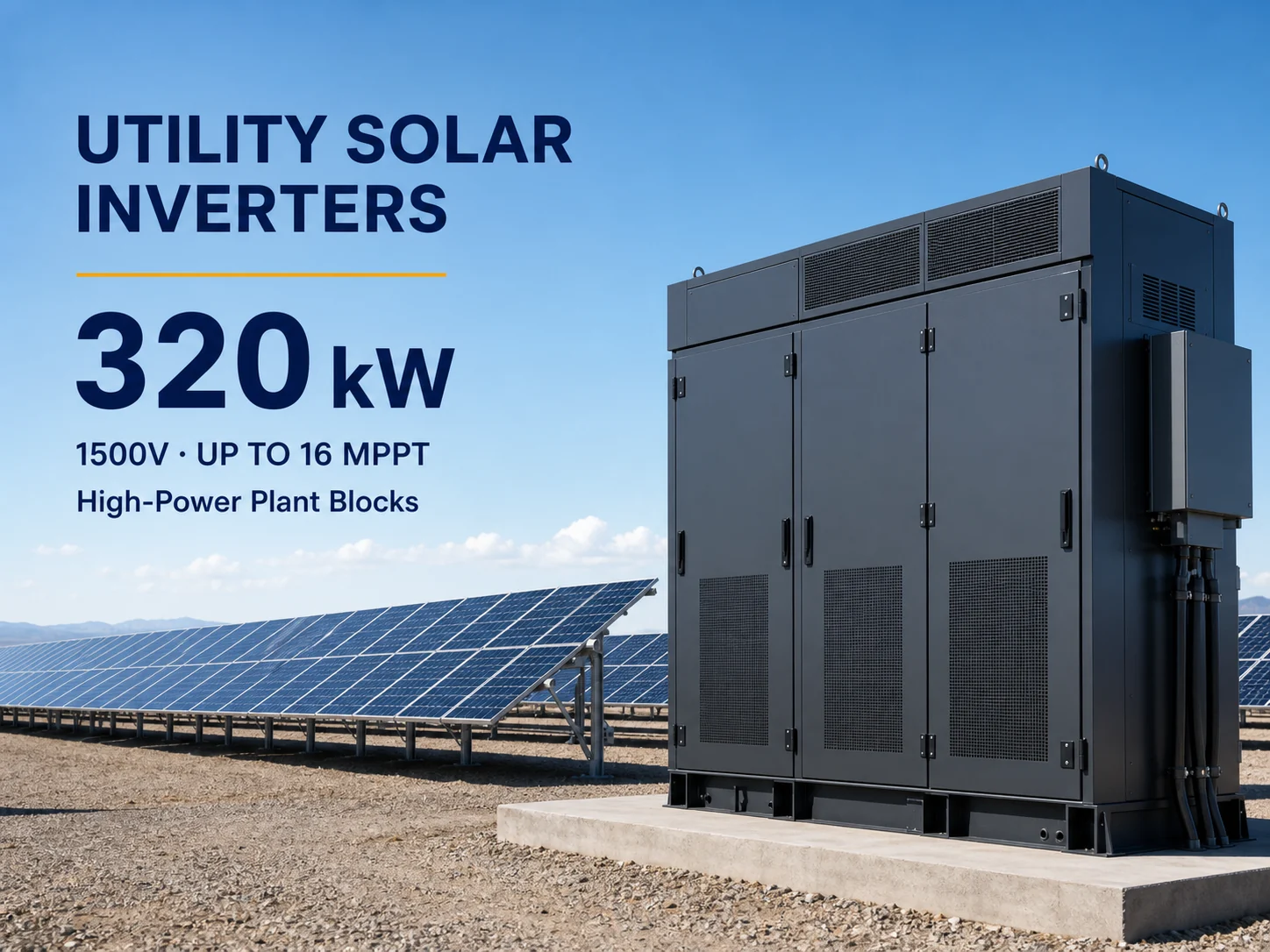
320kW 1500V Multi-MPPT Utility String Inverter Platform
Current source identity: a neutral 320 kW/1500 V utility planning platform; manufacturer, full model, suffix and released factory documents are not attached.
This neutral planning platform describes a 320 kW utility string-inverter class with 1500 V maximum DC, up to 16 MPPT routes and a model-dependent 640–920 V three-phase AC output. It is not a released manufacturer model. Exact MPPT/input current, DC connector architecture, rated AC voltage, transformer interface, protection, plant controller functions, grid-code performance and certificate scope must be selected as part of the utility block design.
Current sourcing-configuration specifications
These values are preserved from the current internal product record. They define shortlist requirements, not a released manufacturer model; require a matching supplier datasheet before order.
PV Input & MPPT
| PV Input | 1500 V DC system; DC oversizing to be engineered for the site |
|---|---|
| MPPT / Inputs | Up to 16 MPPT / DC 2-in-1 input architecture by model |
AC Output & Grid
| Rated AC Output | 320 kW |
|---|---|
| AC Output | 640–920 V three-phase; 50/60 Hz |
| Maximum Efficiency | Up to 99.0% |
Installation & Communication
| DC Voltage | 1500 V maximum DC; operating range to be confirmed with selected model |
|---|---|
| Protection | Outdoor utility enclosure; monitoring and protection options by selected model |
| Communication | RS485 / Ethernet with plant monitoring integration options |
| Recommended Application | Large utility PV plants requiring high-power decentralized inverter blocks |
Current document status
Require the exact inverter datasheet/manual, MPPT and DC-input schedule, AC ratings, protection/options, grid-support functions, PPC/SCADA interfaces, type-test/certificate package, warranty, service and spare-parts proposal.
Current utility-platform evidence
Fix the inverter model and collection voltage before block engineering
The 320 kW label does not define the complete DC, AC, controls or grid-compliance interface.
Power and AC voltage
320 kW and a 640–920 V range are stated at platform level. Confirm rated/max active and apparent power, current, exact AC voltage, power factor, reactive capability and derating.
1500 V DC system
Maximum DC is stated without start/MPPT/rated windows, per-input current, short-circuit current, strings per MPPT, connector/fuse architecture or temperature limits.
Up to 16 MPPT
The final tracker and input count is model-dependent. Terrain/tracker zones, bifacial current, mismatch and cable/combiner strategy must be mapped to the exact input schedule.
Plant interface
RS485/Ethernet and plant monitoring are described generally. PPC/SCADA protocol, time sync, commands, alarms, cybersecurity, weather station and MV-station interfaces need project definition.
320 kW utility RFQ checks
Six engineering packages required for a bankable inverter comparison
Utility procurement requires a traceable model, electrical design basis and project acceptance plan.
Array and tracker zones
Provide module electrical data, bifacial assumptions, temperature range, strings, tracker/terrain zones, cable lengths and expected DC/AC ratio.
DC input limits
Verify cold Voc, MPPT/rated range, Isc/Imp per input and MPPT, string fusing, connectors, DC switch/SPD, insulation monitoring and AFCI/PID options.
AC and MV collection
Define inverter AC voltage/current, transformer winding and vector group, block MVA, cable/busbar, switchgear, fault level, grounding and auxiliary power.
Grid-code studies
State P/Q capability, LVRT/HVRT, frequency response, ramp rate, harmonics, flicker, protection settings and utility model-validation requirements.
Controls and O&M
Confirm PPC/SCADA protocols, remote commands, data resolution, time sync, diagnostics, firmware control, spares, service tools and replacement strategy.
Evidence and acceptance
Request type tests/certificates, datasheet/manual, efficiency and derating curves, warranty, FAT/SAT, commissioning, performance tests, packing and delivery plan.
Utility design boundaries
1500 V, 16 MPPT and 99% do not define plant performance
The exact model, array, transformer, environment, controls and grid requirements determine the accepted utility block.
1500 V maximum is not an operating point
String length must use cold Voc and the actual MPPT/rated window across temperature; current and insulation/protection limits remain equally important.
MPPT count is not a yield guarantee
Yield depends on zone allocation, terrain, mismatch, clipping, availability, soiling, temperature, cable losses and control behavior.
Maximum efficiency is not plant PR
An up-to efficiency label does not include transformer, MV collection, clipping, auxiliary load, curtailment, downtime or environmental derating.
Grid-code capability needs project proof
Generic function labels do not replace the exact firmware, certificate/type test, simulation model, study results, settings and utility witness tests.
Continue the utility-inverter review
Connect inverter inputs to the complete utility procurement package
Use these resources to define project scope and maintain a traceable BOM.
Utility solar procurement solution
Coordinate modules, inverters, MV station, controls, logistics, studies, commissioning and acceptance responsibilities.
Review utility scope →Solar BOM review guide
Define model identity, included accessories, interfaces, quantities, spares and project exclusions before comparing offers.
Review BOM controls →320 kW utility inverter FAQ
Questions to close before freezing the inverter block
Every answer must reference one full model and project design basis.
Is this an exact manufacturer inverter?
No. It is a neutral 320 kW/1500 V planning platform. The bid must identify the full manufacturer model/suffix and attach released technical and grid documents.
Does 1500 V define the string length?
No. Use module cold Voc, temperature range and the exact inverter maximum/start/MPPT/rated windows, plus current, connector and protection limits.
Can any 640–920 V inverter connect to the same transformer?
No. Fix rated AC voltage/current, transformer winding/vector group, MVA, impedance, grounding, fault level, cable/switchgear and protection coordination.
What should utility acceptance include?
Define document review, model validation, FAT/SAT, commissioning, controls/communications, protection, grid-code witness tests, performance criteria, punch list and handover files.
Prepare a 320 kW utility inverter technical RFQ
Send the module/string and block design, site climate, AC/MV collection, grid-study requirements, PPC/SCADA scope, acceptance plan and mandatory model documents.
Start with the product, application or project information you have. We can help identify the remaining configuration, document or delivery questions before a final quotation.
Verify the Utility PlatformRelated Products
150kW Utility String Inverter
150 kW platform for ground-mount and large c&i pv plants on 1000/1100 v dc systems.
200kW / 215kVA 1500V Utility Multi-MPPT String Inverter
200 kW rated / 215 kVA maximum platform for 1500 v ground-mount pv plants and high-capacity tracker blocks.
3.2MW Medium-Voltage Utility PV Station
Approx. 3.2 MW AC platform for utility-scale ground-mount pv plants requiring a pre-integrated inverter and mv transformation solution.